21/07/2025
Công Ty TNHH Thương Mại Metal A


USD exchange rate increases to record high
Date 21-07-2025 Views 121

Domestic USD price surges, many banks list selling price above 25,770 VND. What causes the greenback to increase so rapidly?
Central exchange rate sets new record, USD continues to increase
This morning (February 12), the State Bank of Vietnam announced the central exchange rate at 24,550 VND/USD, up 28 VND compared to yesterday. This is the highest level ever, reflecting the strong increase of USD in the global market.
With a margin of plus/minus 5%, commercial banks today are allowed to trade USD in the range of 23,373 - 25,727 VND/USD.
At the State Bank of Vietnam, the reference exchange rate today also increased sharply:
Buy: 23,373 VND/USD
Sell: 25,727 VND/USD (up 29 VND)
Bank USD, black market increase sharply
At commercial banks, the USD price today continues to increase sharply. The black market USD price continues to increase, approaching 25,800 VND/USD.
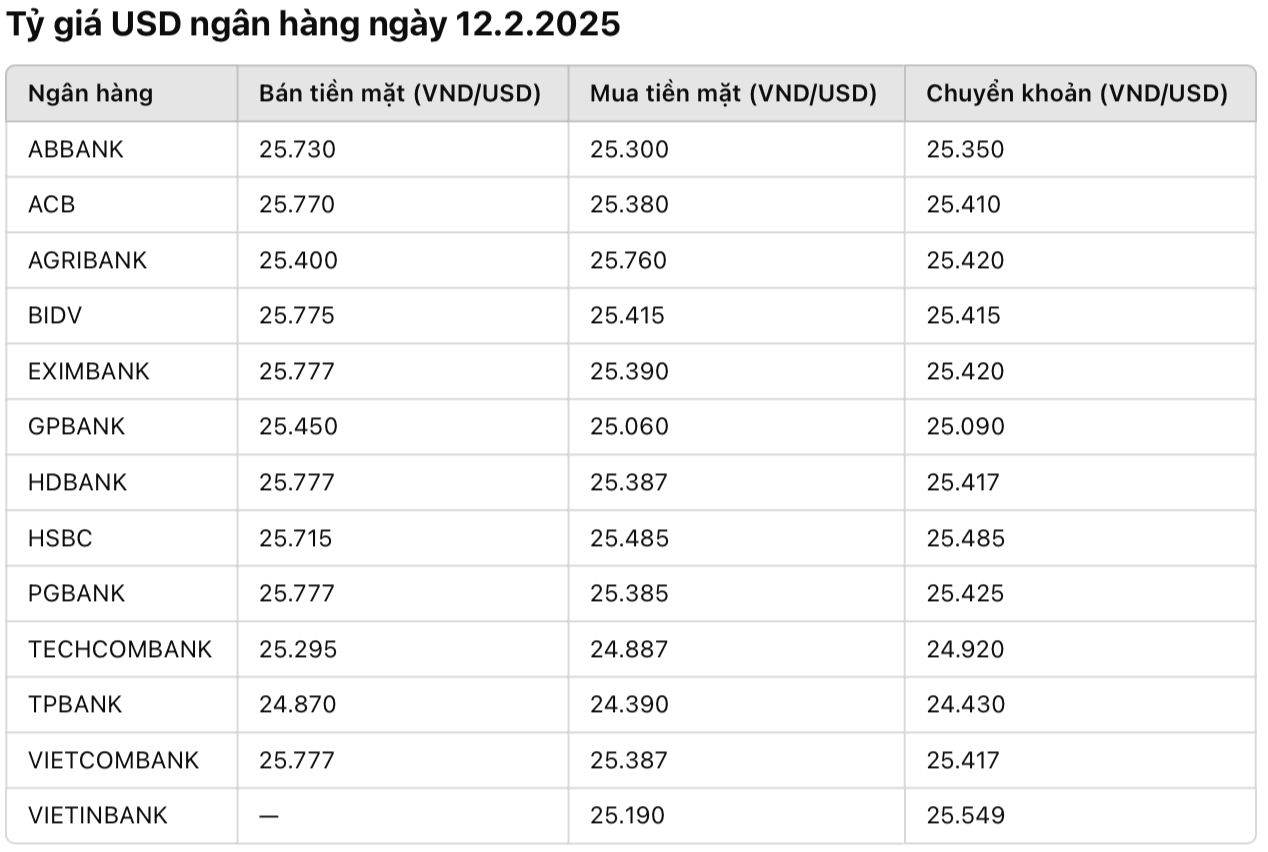
Banks with the highest USD selling price: Eximbank, HDBank, PGBank, Vietcombank (selling at 25,777 VND/USD).
Banks with the highest USD buying price: HSBC (25,485 VND/USD).
The difference between buying and selling prices at banks ranges from 300 - 500 VND/USD.
Thus, the USD exchange rate today is still maintained at a record high, with the common selling price above 25,700 VND/USD.
Why does the USD continue to increase strongly?
The domestic USD price has increased rapidly mainly due to the influence of developments in the international market. Currently, the greenback continues to maintain a strong increase compared to other key currencies, pushing the USD/VND exchange rate to its highest level in many months.
According to data recorded at 10:24 on February 12, the US Dollar Index - a measure of the strength of the USD compared to a basket of major currencies - reached 108 points, up 3.68% after 1 year.
One of the main reasons for the strengthening of the USD is the escalating trade tension between the US and China. After US President Donald Trump announced a 25% tariff on all imported steel and aluminum products, China immediately responded by announcing a list of US products subject to new tariffs. This move raised concerns about a prolonged trade war, making the USD a safe haven, attracting investment flows.
In addition, the risk of inflation in the US is also increasing as import tariffs can cause prices of goods to escalate. In this situation, the US Federal Reserve (Fed) is likely to maintain a high interest rate policy to control inflation. This policy makes the USD even more attractive to investors, pushing the USD exchange rate to its highest level in many months.
With the above factors, the USD is maintaining a strong upward trend and shows no signs of cooling down.
Source: Minh Anh (Lao Dong Newspaper)
Tin liên quan
- Production situation at Chinese steel mills
- Bearish sentiment dominates China's thermal coal market
- South Korea officially imposes anti-dumping duties on Chinese stainless steel plates
- Heavy losses continue to hold back China's electric furnace (EAF) steel output
- Mongolia's coal exports to China down 8.3% month-on-month in May
- Malaysia extends anti-dumping duties on cold-rolled steel coil from China and Japan, ending them on South Korea and Vietnam


Contact Us

Contact Us

Contact Us

Contact Us

Contact Us

